
Manganese is a “vitamin” for the steel industry and a key raw material for new energy batteries. However, most manganese ores currently are low-grade and difficult to beneficiate, with a direct mining utilization rate of less than 30%. The selection and optimization of beneficiation methods for low-grade manganese ore are crucial to turning “waste ore” into “resources.” Manganese beneficiation testing is a core step in determining whether the ore can be economically utilized. However, many companies experience low recovery rates and high costs due to non-standard testing procedures. This article will break down the key steps of manganese beneficiation tests in detail, helping you avoid common pitfalls and optimize your testing process.
Key steps in manganese beneficiation testing are crucial for improving the utilization rate of low-grade manganese ore. From ore sample preparation and property analysis, and test scheme design, to core process experiments such as gravity separation, flotation, magnetic separation, and leaching, each step helps you standardize your process, improve recovery rate and grade, and enable the economical utilization of low-grade manganese ore.
Table of Contents
Purpose of Manganese Beneficiation Tests
(1) Determining the ore’s suitability and economic value
Different types of manganese ore (such as manganese oxide ore and manganese carbonate ore) have different physicochemical properties, directly affecting the applicability of beneficiation methods. Laboratory-scale experiments can quickly identify the ore’s mineral composition, dissemination characteristics, and the occurrence state of manganese. This allows for the simulation of recovery rates and grade improvement potential under different processes (flotation/magnetic separation/gravity separation), and then determining whether sufficient recovery potential exists.
(2) Optimizing the process flow to improve manganese recovery rate and grade
During the experiment, different beneficiation methods (such as gravity separation, magnetic separation, flotation, or leaching) will be compared to screen for the most efficient process combination. For example, pyrolusite is suitable for magnetic separation, rhodochrosite requires flotation, and mixed ores may require a combined process. Furthermore, the experiment will adjust key parameters (such as grinding fineness, magnetic field strength, reagent dosage, etc.) to find the optimal operating conditions.
(3) Providing data support for subsequent large-scale mineral processing plant design
The test results can help engineers determine the most suitable equipment selection (such as crushers, mills, and sorting equipment), process flow configuration (single-stage or multi-stage sorting), and production line capacity requirements. Furthermore, the test data can be used to estimate operating costs (such as electricity consumption, wastewater treatment, tailings disposal, and labor costs), helping companies conduct economic feasibility analyses and ensuring that the mineral processing plant design complies with national environmental protection standards.
Preparations before manganese beneficiation testing
1. Ore Sampling and Preparation
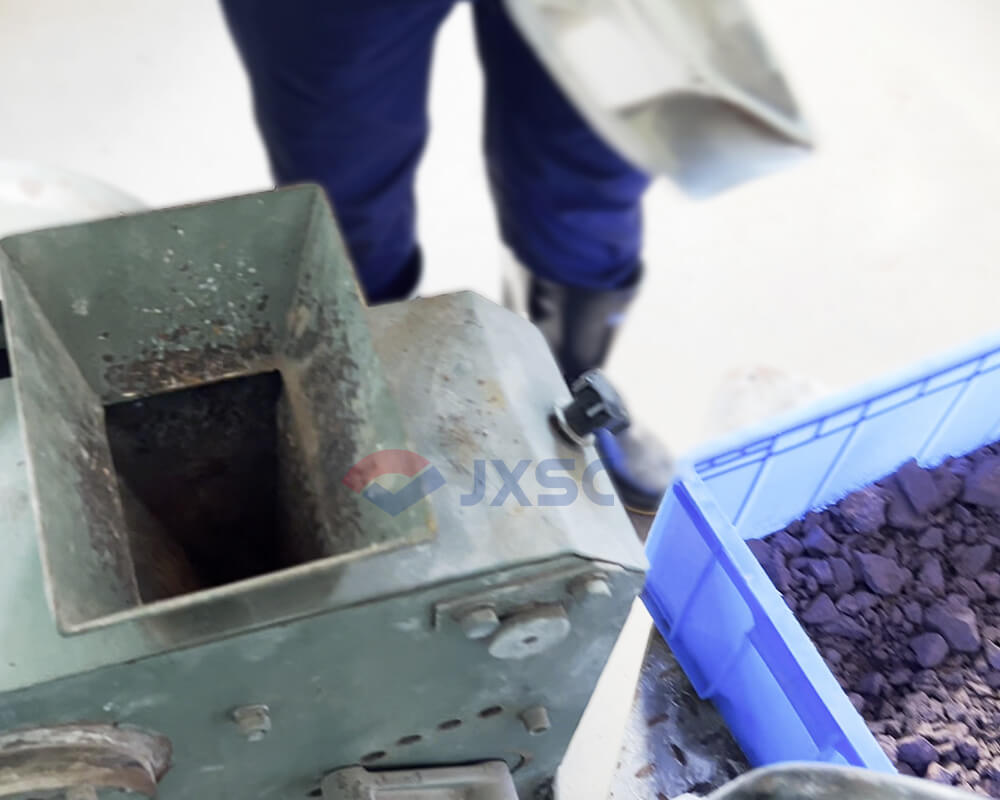
The selection of representative mineral samples should follow the principles of “multiple points, stratification, and equal quantity” to avoid distorted test results due to sample segregation. After sampling, the ore needs to be sent to the laboratory for crushing and grinding to achieve a particle size suitable for mineral processing tests.
Uneven sample crushing may lead to deviations in test results. Therefore, particle size distribution must be strictly controlled during grinding, and particle size analyzers should be used for testing when necessary.
2. Property Testing
After sample preparation, a systematic analysis of the physicochemical properties of the manganese ore is required.
- Physical analysis: For example, X-ray diffraction (XRD) to identify the mineral composition, such as the proportion of rhodochrosite, pyrolusite, or limonite.
- Chemical analysis: Determining the manganese grade and the content of harmful impurities, such as iron and phosphorus.
The occurrence state of different minerals (free or encapsulated), their particle size (determining grinding fineness), and their beneficiation properties (whether complex processes are needed to separate impurities) all reveal key characteristics of the ore. Through these analyses, we can also preliminarily determine which beneficiation method is most effective. For example, if rhodochrosite accounts for a large proportion, flotation should be given priority; if magnetic iron minerals are present, magnetic separation should be combined.
3. Preliminary Test Plan Design
If XRD indicates the ore is primarily composed of manganese carbonate minerals (such as rhodochrosite), flotation is likely the preferred method. If the ore is rich in manganese oxide and has strong magnetic properties (such as malachite), magnetic separation will be more efficient. High-intensity magnetic separation is suitable for magnetic manganese ores, while leaching is suitable for low-grade manganese oxide ores.
Key Steps in Manganese Beneficiation Tests
1). Gravity Separation Tests
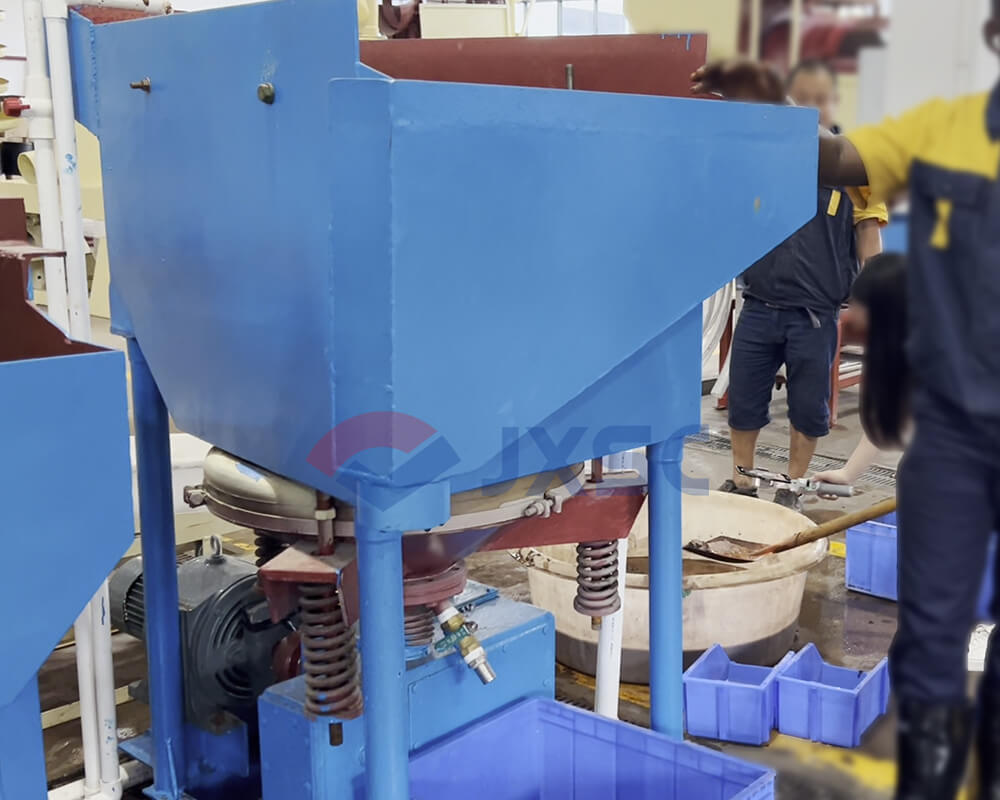
For medium-grade (Mn 25%-35%) coarse-grained disseminated ores, conditional tests are typically conducted on laboratory-scale jigs. Key parameters include bed thickness, stroke flow rate, and feed concentration. The goal is to obtain a concentrate with Mn grade >40% from the coarse-grained fraction. Shaking table tests require careful control of bed inclination angle, flushing water flow rate, and stroke. These methods are suitable for fine-grained manganese ores of 0.1-2 mm with high enrichment ratios. Gravity separation tests need to consider the ore particle size distribution to achieve an efficient combination of “coarse-grained tailings removal + fine-grained enrichment.” For example, jigs are preferred for coarse-grained fractions, while shaking tables are used for fine-grained fractions. However, for fine-grained fractions of -0.074 mm, the efficiency of traditional gravity separation drops sharply; in this case, centrifugal concentrators or flotation processes should be considered.
2). Magnetic Separation Test
A wet high-intensity magnetic separator was used to process weakly magnetic manganese minerals. The focus was on optimizing the gap between the magnetic media and the amount of washing water to prevent gangue from being entrained in the magnetic product. High-intensity magnetic separation is suitable for separating rhodochrosite. For mixed ores containing magnetite, weak magnetic separation can be used, while adjusting the feed rate to prevent excessive slurry flow that could lead to metal loss. Magnetic separation technology has unique advantages for weakly magnetic manganese minerals (such as rhodochrosite and malachite), and its separation effect mainly depends on the mineral’s specific magnetic susceptibility and embedding characteristics. However, for manganese oxide ores containing a large amount of clay minerals, a dispersion and desliming process needs to be added before magnetic separation to avoid magnetic loss caused by slime encapsulation.
3). Flotation Test
Rhodochrosite (manganese carbonate) requires fatty acid collectors, which adsorb manganese ions by forming complexes. Pyrolusite (manganese oxide) requires amine collectors, which function under alkaline conditions. The depressants must selectively inhibit gangue: for example, water glass can inhibit quartz, and starch can inhibit iron minerals. The selectivity of flotation reagents is the core factor determining the flotation effect of manganese ore, and it is essential to select appropriate reagents based on the mineral type.
4). Leaching
Leaching is an effective method for treating difficult-to-process manganese ores, such as low-grade, ultra-lean, or high-iron manganese ores. The core principle is to dissolve manganese from the ore using chemical methods. For complex manganese ores with high phosphorus and sulfur content, leaching tests also require the addition of impurity removal agents (such as sodium sulfide for heavy metal removal). Most importantly, the leaching time and stirring speed must be evaluated: too long a time increases energy consumption, while too short a time results in incomplete leaching. However, adopting this process requires careful assessment of the site’s feasibility, given the stringent requirements of local mine climate (rainfall) and topography (permeability).
In summary, ore sampling and preparation ensure the representativeness of the experiment, physical and chemical analysis guides process selection, manganese beneficiation tests verify the ore’s utilization value, and process optimization improves performance indicators. Further testing using a combination of processes is needed to maximize benefits. This could involve comparing gravity separation, magnetic separation, and flotation tests to assess differences in recovery rate and grade. Ideally, repeated verification and optimization of the process are required to ensure stable results before proceeding to the industrial design stage. Finally, calculating and recording data such as ore quantity, grade, and recovery rate at each stage, and then compiling an analysis report, transforms the experimental results into practical applications.
Conclusion
Manganese beneficiation testing is a core step in the utilization of low-grade manganese ore, encompassing sampling and preparation, physical/chemical analysis, and beneficiation tests (gravity separation/magnetic separation/flotation/leaching). Through process optimization and data analysis, the optimal process flow for manganese ore of different grades is determined. If you have manganese ore testing needs, JXSC (Asia-Africa International) provides precise mineral liberation analysis and process simulation, maximizing the balance between recovery and grade to over 95%. Contact us for customized lab beneficiation solutions and equipment tailored to your mineral composition, distribution characteristics, grade, and other conditions!